
What Buyers Should Know About MEDDPICC
Most executives have never heard of MEDDPICC.
Many software sales teams, however, think about it every day.
If you've ever wondered why software vendors keep asking about stakeholders, budgets, timelines, business outcomes and procurement processes, there's a good chance MEDDPICC is influencing the conversation.
MEDDPICC is one of the most widely used sales qualification frameworks in enterprise technology companies. It helps sales teams determine whether an opportunity is likely to close, what risks exist, and where they should invest their time.
Understanding MEDDPICC won't make you a salesperson.
But it will help you become a more informed buyer.
Why Buyers Should Care About MEDDPICC
Many buyers assume MEDDPICC is simply a framework used by individual salespeople.
In reality, it is often deeply embedded into how software companies operate.
At many SaaS and enterprise software vendors, sales onboarding programs, bootcamps and ongoing training are heavily focused on MEDDPICC. Salespeople are trained to identify and document each component throughout the sales cycle.
The framework doesn't stop with training.
CRM systems such as Salesforce are frequently configured with fields specifically designed to capture MEDDPICC information. Salespeople are often expected to document:
- Economic Buyers
- Business Pain
- Champions
- Decision Criteria
- Procurement Processes
- Competition
This information is then reviewed during pipeline inspections, forecast meetings and management reviews.
Conversation intelligence platforms such as Gong have taken this even further.
Many organisations use call recording and AI analysis to determine whether salespeople uncovered business pain, identified decision-makers, discussed metrics or established a clear buying process during customer conversations.
Managers often review this information when evaluating sales performance and deal quality.
In other words, MEDDPICC isn't simply a sales methodology.
It's often a management system.
Understanding this context helps explain why vendors consistently ask certain questions and why some topics receive so much attention during software evaluations.
The questions are rarely random.
More often than not, they are directly connected to a framework the salesperson is expected to follow, document and report on internally.
What Is MEDDPICC?
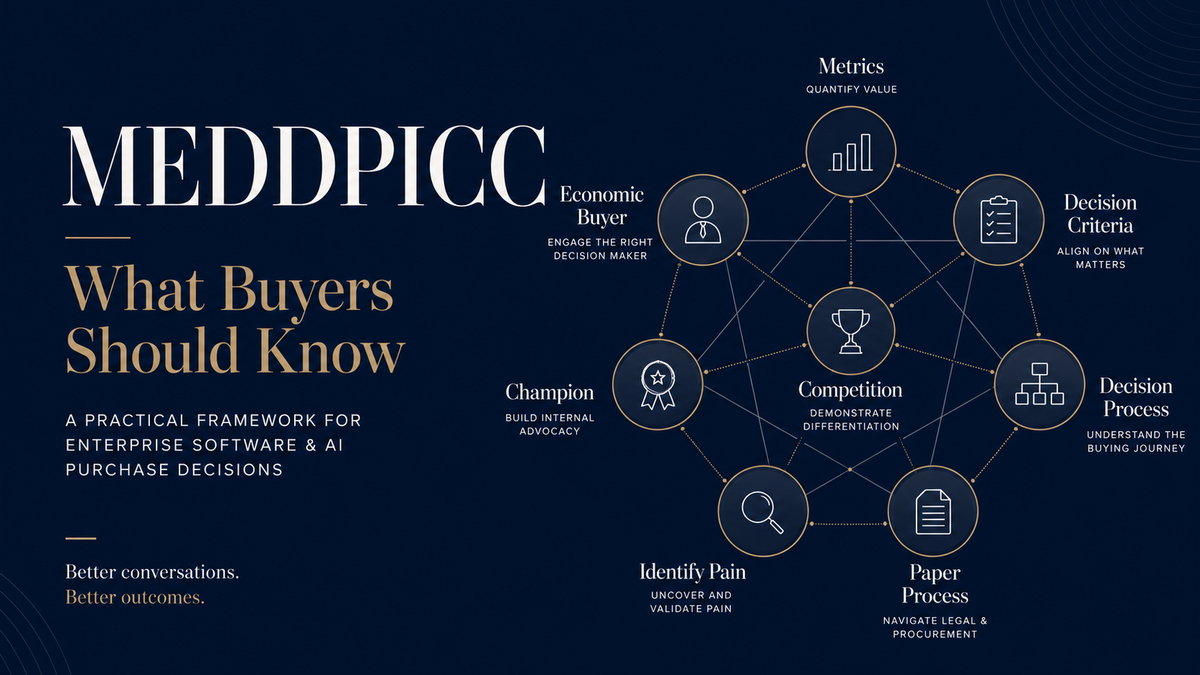
MEDDPICC stands for:
- Metrics
- Economic Buyer
- Decision Criteria
- Decision Process
- Paper Process
- Identify Pain
- Champion
- Competition
The framework helps sales teams answer one simple question:
What needs to happen for this opportunity to be successful?
Let's look at each component through a buyer's lens.
Metrics
Metrics are the measurable business outcomes a vendor hopes to influence.
Examples include:
- Reducing operating costs
- Increasing productivity
- Improving retention
- Accelerating onboarding
- Reducing risk
This is why vendors often ask:
- What outcomes are you trying to achieve?
- How will success be measured?
- What does success look like in twelve months?
Buyer's Insight
The strongest software initiatives are tied to measurable business outcomes.
If success cannot be measured, it becomes much harder to secure funding, executive support and stakeholder alignment.
Economic Buyer
The Economic Buyer is the individual who ultimately has authority to approve the investment.
This may be:
- CFO
- CIO
- CTO
- COO
- CHRO
- Business Unit Leader
This explains why salespeople often ask:
- Who signs off?
- Who owns the budget?
- Who else is involved in the decision?
Buyer's Insight
Many projects slow down because key decision-makers are introduced too late.
Early stakeholder alignment usually leads to faster and smoother buying processes.
Decision Criteria
Decision criteria are the factors used to evaluate vendors.
Examples include:
- Security
- Functionality
- Integrations
- Vendor stability
- Support quality
- Cost
Vendors want to understand:
How will we be evaluated?
Buyer's Insight
Defining evaluation criteria upfront often produces better vendor responses and more objective decision-making.
Decision Process
Decision criteria explain what matters.
Decision process explains how the decision gets made.
Examples include:
- Vendor shortlisting
- Demonstrations
- Security reviews
- Procurement reviews
- Executive approvals
Buyer's Insight
Many delays occur because vendors and stakeholders don't fully understand the buying process.
Transparency usually benefits everyone involved.
Paper Process
Enterprise software purchases often require:
- Legal review
- Procurement review
- Security review
- Compliance review
This process can sometimes take longer than the evaluation itself.
Buyer's Insight
When vendors ask about procurement processes early, they are often trying to avoid surprises later in the buying cycle.
Identify Pain
Pain refers to the business problem that justifies change.
Examples include:
- Rising costs
- Manual processes
- Compliance risks
- Poor visibility
- Customer experience challenges
Without meaningful pain, there is often little momentum for change.
Buyer's Insight
The clearer the business problem, the easier it becomes to build a compelling business case internally.
Champion
A Champion is an internal advocate who helps move a project forward.
This is often:
- A project sponsor
- A transformation lead
- A department leader
- A power user
Buyer's Insight
Successful projects almost always have internal advocates who help build alignment and maintain momentum.
Competition
Competition doesn't always mean another vendor.
It could be:
- An internal build
- Existing systems
- A competing priority
- Doing nothing
Vendors want to understand what alternatives they are competing against.
Buyer's Insight
The strongest evaluations compare solutions against business outcomes rather than feature checklists.
How Buyers Can Use MEDDPICC To Their Advantage
Understanding MEDDPICC doesn't mean helping vendors sell more software.
It means understanding the incentives and frameworks influencing the conversation.
That knowledge can be surprisingly useful.
Understand Why Certain Questions Are Being Asked
When vendors ask about:
- stakeholders
- budget
- timelines
- business outcomes
- procurement
they're not simply gathering information.
They're assessing risk.
Understanding this helps buyers separate genuine discovery from qualification requirements.
Maintain Negotiating Leverage
Many buyers reveal too much information too early.
For example:
- exact budgets
- preferred vendors
- hard deadlines
before fully evaluating the market.
The goal isn't to be evasive.
The goal is to make informed decisions before giving away unnecessary leverage.
Use Competition Strategically
Competition is one of the final components of MEDDPICC for a reason.
Vendors know competitive deals require them to perform at a higher level.
A structured evaluation involving multiple vendors can often improve:
- pricing
- responsiveness
- executive attention
- implementation support
- commercial flexibility
Control Executive Access
Vendors often seek meetings with CFOs, CIOs and executive sponsors because MEDDPICC places significant emphasis on Economic Buyers.
Executive access is valuable.
Understanding why vendors want it allows buyers to control when and how senior stakeholders become involved.
Recognise When Forecast Pressure Creates Leverage
MEDDPICC doesn't operate in isolation.
It feeds directly into pipeline reviews and forecast meetings.
Deals that appear likely to close often receive:
- additional executive support
- faster responses
- commercial flexibility
- pricing concessions
Buyers who understand this dynamic are often better positioned to negotiate favourable outcomes.
The Buyer's Side Take
MEDDPICC isn't a secret sales weapon.
It's simply a framework used by software vendors to understand whether a project is likely to succeed.
For buyers, understanding MEDDPICC provides something far more valuable:
Context.
When you understand the incentives, frameworks and pressures influencing vendor behaviour, you become a stronger negotiator, a more informed buyer and ultimately a better decision-maker.
The goal isn't to beat the vendor.
The goal is to make better technology decisions.
Related Reading:
What Software Vendors Are Really Trying To Learn During Discovery Calls
What Happens Inside A SaaS Forecast Meeting