
What Happens Inside A SaaS Forecast Meeting
Most buyers never see what happens after a sales call ends.
Once the meeting is over and the vendor logs off, the opportunity often enters a completely different process: the forecast.
Inside most SaaS and enterprise software companies, salespeople attend regular forecast meetings where they explain which deals are likely to close, what risks exist, and what support they need from the wider organisation.
These meetings influence far more than most buyers realise.
They can affect:
- Pricing flexibility
- Executive involvement
- Resource allocation
- Escalation priority
- Negotiation behaviour
Understanding how forecast meetings work can help buyers make sense of many of the behaviours they experience during software evaluations.
What Is A Forecast Meeting?
A forecast meeting is a regular review where salespeople present their opportunities to management.
Participants often include:
- Account Executives
- Sales Managers
- Regional Directors
- Vice Presidents
- CROs (Chief Revenue Officers)
The purpose is simple:
Predict future revenue as accurately as possible.
Public companies report revenue to shareholders.
Private companies report revenue to investors and boards.
Forecast accuracy matters.
A lot.
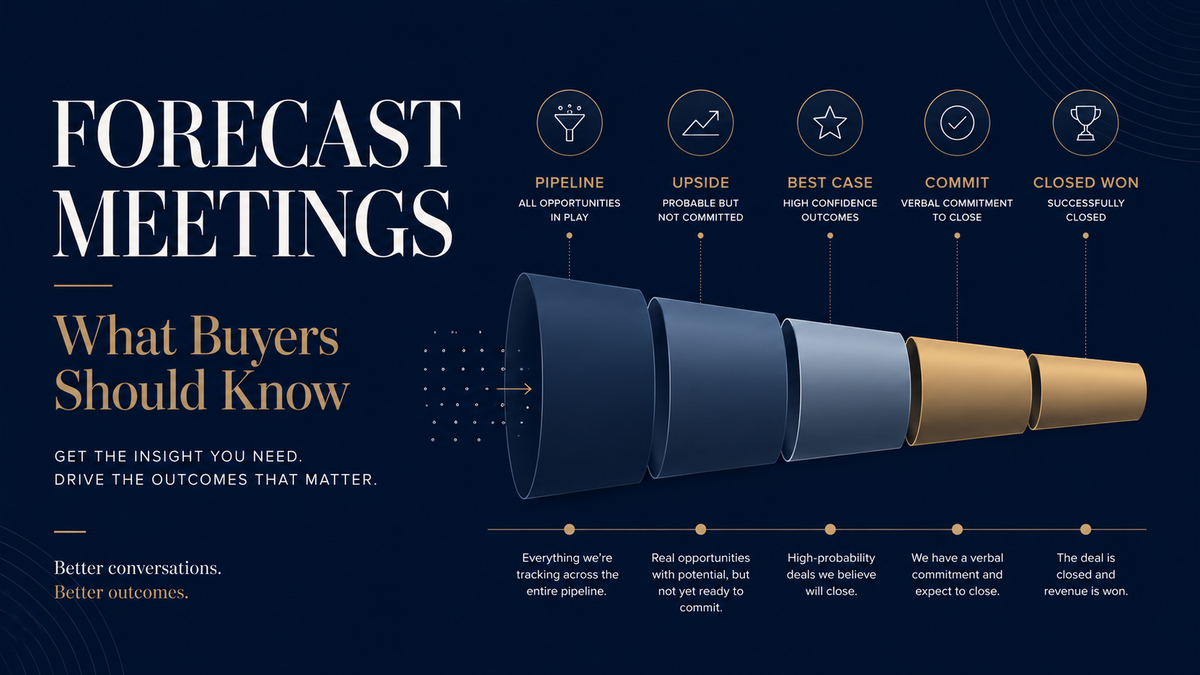
The Pipeline Categories Buyers Never See
Most sales organisations categorise opportunities into different forecast stages.
While terminology varies between companies, the categories often look something like this:
Pipeline
Early opportunities.
There is interest, but significant uncertainty remains.
These deals are not expected to close soon.
Upside
Deals that could close if things go well.
They are possible, but not yet predictable.
Best Case
Deals with a reasonable chance of closing within the forecast period.
Management is paying attention.
Commit
Deals the salesperson is effectively committing to close.
Management expects these opportunities to land.
Closed Won
The deal is signed.
Revenue becomes real.
Why Managers Care About MEDDPICC
In many forecast meetings, managers aren't interested in hearing:
"The customer liked the demo."
Instead, they ask questions such as:
- Have you identified the Economic Buyer?
- What business pain are they solving?
- Is there a Champion?
- What is the decision process?
- What competition exists?
- Has procurement been engaged?
Sound familiar?
These are MEDDPICC questions.
Forecast meetings are often where MEDDPICC becomes operational.
The framework helps managers determine whether an opportunity belongs in Pipeline, Upside, Best Case or Commit.
Why Salespeople Seem Obsessed With Certain Questions
Many buyers become frustrated when vendors repeatedly ask about:
- Timelines
- Stakeholders
- Procurement
- Budget
- Approval processes
The reason is simple.
Salespeople need answers.
Not only for themselves, but for their managers.
When a manager asks:
"Why is this deal in Commit?"
the salesperson needs evidence.
MEDDPICC provides that evidence.
How Forecast Meetings Influence Buyer Experience
This is where things become interesting.
The forecast category assigned to your opportunity can directly influence the experience you receive as a buyer.
Executive Attention
Deals expected to close often receive executive support.
Suddenly:
- VPs appear
- CROs join calls
- Executive sponsors become available
This isn't necessarily manipulation.
It's resource allocation.
The company is investing time where it expects results.
Faster Responses
Deals under close management scrutiny often receive:
- Faster follow-ups
- Faster pricing approvals
- Faster legal reviews
Internal urgency increases.
Additional Resources
A deal nearing commitment may receive:
- Solution architects
- Business value consultants
- Executive briefings
- Additional implementation support
Resources that might not have been available earlier suddenly become available.
Why Quarter-End Behaviour Changes
Forecast meetings become increasingly important near quarter-end.
As deadlines approach:
- Forecast scrutiny increases
- Management pressure increases
- Revenue targets become more visible
This is often when buyers notice:
- Increased follow-up activity
- Additional executive involvement
- Discounting conversations
- Requests to accelerate timelines
Understanding forecast pressure helps explain why vendor behaviour can change dramatically as quarter-end approaches.
How Buyers Can Use This Knowledge
Understanding forecast meetings doesn't mean taking advantage of vendors.
It means understanding the incentives driving the conversation.
Recognise When You Have Leverage
A vendor that urgently needs your deal to close may be more flexible than a vendor with a healthy forecast.
Understand Why Executive Access Matters
Executive meetings aren't always about relationship building.
Sometimes they are about reducing forecast risk.
Create Competitive Tension
Forecast pressure combined with competition can often improve:
- Commercial terms
- Responsiveness
- Access to resources
Focus On Outcomes
The strongest buyers keep discussions focused on business outcomes rather than vendor timelines.
The vendor's quarter-end isn't your quarter-end.
Your objective is to make the best decision for your organisation.
The Buyer's Side Take
Forecast meetings are not inherently good or bad.
They're simply how software companies manage their business.
But understanding them provides buyers with valuable context.
The next time a vendor suddenly becomes more responsive, introduces an executive sponsor, or pushes harder to close before quarter-end, there's a good chance a forecast meeting is influencing that behaviour.
The more you understand the internal systems guiding vendor behaviour, the more effectively you can navigate the buying process.
Related Reading
- What Software Vendors Are Really Trying To Learn During Discovery Calls
- What Buyers Should Know About MEDDPICC