
How Software Salespeople Are Really Compensated
Most buyers understand that software salespeople earn commission.
Far fewer understand how compensation plans actually work, and how those plans influence behaviour throughout the buying process.
If you've ever wondered why a salesperson suddenly becomes more responsive near quarter-end, why executives appear unexpectedly during negotiations, or why some deals receive extraordinary attention, compensation is often part of the answer.
Understanding how software salespeople are measured and rewarded won't make you a salesperson.
But it will help you become a more informed buyer.
The Goal Isn't Revenue. It's Quota.
Many buyers assume software salespeople are simply trying to generate as much revenue as possible.
That's not entirely true.
Most enterprise salespeople are focused on a specific target known as a quota.
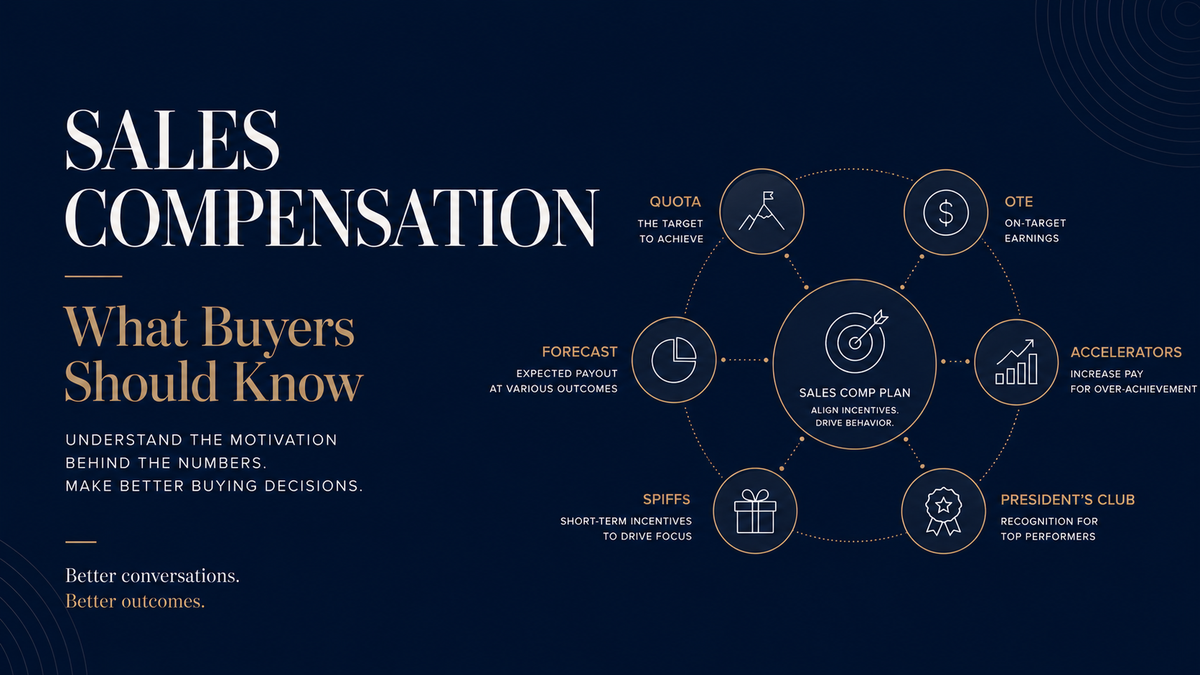
A quota is the amount of revenue a salesperson is expected to generate within a given period.
For example:
- Annual quota: $1.5M ARR
- Quarterly quota: $375k ARR
Everything revolves around quota attainment.
When salespeople discuss opportunities internally, they are often thinking about one question:
Will this deal help me hit my number?
Base Salary, Commission and OTE
Most enterprise software salespeople are paid through a combination of:
- Base salary
- Variable commission
Together these form OTE, or On-Target Earnings.
For example:
- Base salary: $150,000
- Commission at quota: $150,000
- OTE: $300,000
If the salesperson achieves 100% of quota, they earn their full OTE.
Miss quota and earnings decrease.
Exceed quota and earnings can increase dramatically.
The Power Of Accelerators
Many compensation plans include accelerators.
Accelerators increase commission rates once quota has been achieved.
For example:
- 0% - 100% of quota = normal commission
- 100% - 120% of quota = 2x commission
- 120%+ of quota = 3x commission
This means a deal closed late in the year can sometimes be worth significantly more to a salesperson than an identical deal closed earlier.
Buyer's Insight
Not all deals have equal value to the salesperson.
The same contract may have very different importance depending on where the salesperson sits against quota.
Why Quarter-End Feels Different
Many buyers notice a change in behaviour near the end of a quarter.
Suddenly:
- Follow-ups become more frequent
- Executives become available
- Pricing flexibility appears
- Internal approvals happen faster
This is often because quota deadlines are approaching.
Forecast meetings become more intense.
Managers scrutinise opportunities more closely.
Revenue targets become increasingly important.
Buyer's Insight
The vendor's quarter-end may create urgency for them.
It does not automatically create urgency for you.
Understanding this distinction can help buyers negotiate from a position of strength.
What Are SPIFFs?
A SPIFF is a short-term incentive designed to encourage specific behaviour.
Examples include:
- Selling a new product
- Closing deals before a deadline
- Winning against a competitor
- Expanding within an existing customer
A salesperson may receive additional compensation for achieving these objectives.
Buyer's Insight
Occasionally a vendor's enthusiasm for a particular product or package may be influenced by internal incentives that are invisible to the buyer.
That doesn't mean the recommendation is wrong.
It simply means buyers should understand that incentives exist.
President's Club And Recognition Programs
Compensation isn't always financial.
Many software companies run recognition programs for top performers.
These can include:
- President's Club trips
- Executive recognition
- Awards
- Career advancement opportunities
These incentives can be surprisingly powerful.
For some salespeople, achieving President's Club is as important as the commission itself.
Why Executive Sponsors Suddenly Appear
Buyers are often surprised when senior executives become involved late in a sales cycle.
You might suddenly see:
- Regional Vice Presidents
- CROs
- CEOs
- Executive Sponsors
This often happens because the opportunity has become strategically important.
The deal may be:
- Large
- Competitive
- Forecasted to close soon
- Important to quota attainment
Buyer's Insight
Executive involvement is often a signal that the deal matters internally.
That can create additional leverage for buyers.
How Buyers Can Use This Knowledge
The purpose of understanding compensation isn't to exploit vendors.
It's to better understand the incentives influencing behaviour.
Recognise The Difference Between Your Urgency And Theirs
A salesperson's urgency may be driven by:
- Quota
- Forecast pressure
- Quarter-end
- Internal incentives
Your urgency should be driven by:
- Business outcomes
- Risk
- Strategic priorities
These are not always the same thing.
Understand When You Have Leverage
If a deal is strategically important to a vendor, they may be willing to provide:
- Better pricing
- Additional support
- Executive access
- Improved commercial terms
Focus On Outcomes
The best buyers remain focused on business value.
Compensation plans change.
Quotas change.
Fiscal years end.
The software you select may remain in your organisation for years.
Optimise for outcomes, not vendor timelines.
The Buyer's Side Take
Software salespeople are not simply chasing revenue.
They are operating within a system of quotas, forecasts, compensation plans and performance expectations.
Understanding those incentives provides valuable context for buyers.
The next time a vendor suddenly becomes more responsive, introduces senior executives or pushes hard to close before a deadline, there is a good chance compensation and quota attainment are influencing the behaviour.
The goal isn't to take advantage of that knowledge.
The goal is to make better decisions.